

Revenue
$500.00M
2023
Valuation
$1.00B
2024
Funding
$330.50M
2024
Growth Rate (y/y)
42.9%
2023
Revenue
Click here for our full ShipBob dataset.
Sacra estimates that ShipBob generated $500M of revenue in 2023, up 43% from $350M in 2022, largely off the growth in gross merchandise value (GMV) via their deal with TikTok Shop U.S., which is projecting sales of $17.5B for 2024.
ShipBob has fulfilled over 1 billion units globally to date and ships approximately 100 million orders annually as of August 2025. During BFCM 2025, ShipBob shipped over 10 million units over the weekend with 99.99% API and dashboard uptime across 2025 and 10% faster delivery times versus 2024.
As ShipBob expanded from 4 warehouses in 2017 to 50 as of 2024, they went from a B2B Shyp to the fulfillment arm of Shopify, helping merchants launch next- and 2-day shipping to go up against Amazon—they benefited massively as Shopify grew revenue 15x from 2015 to 2020, from $200M to $3B.
Valuation & Funding
ShipBob is reportedly seeking a $4 billion valuation for its upcoming IPO as of 2024. The company has raised over $330.50 million in total funding across multiple rounds. Its most significant raise was a $200 million Series E round in 2021, led by Bain Capital Ventures.
In May 2025, ShipBob hired Adam Patnaude as CFO, bringing 25+ years of experience in capital structure, M&A, and investor relations; at Grubhub he helped scale Gross Transaction Value from roughly $2.5B to over $10B. Prior to the planned IPO, Bain Capital Ventures stands as a notable investor in the company, having led the company's last major funding round in 2021.
Product
In 2013, Shyp hit 50-100% month-over-month growth for its service that picked up your packages within 20 minutes and shipped them for a flat $5 fee, but it failed to scale because consumers ship irregularly and in low volumes.
Shyp partnered with eBay in 2016 as part of a pivot to B2B, with revenue per transaction increasing by 150% as a result, but the lack of runway left from their first ~3 years losing money on every B2C order meant they had to shut their doors in 2018.
That pattern of product-market fit emerged again with ShipBob, which launched in 2015 to bring scheduled package pickup and shipping to SMBs selling across eBay, Shopify and Etsy, monetizing by charging $5 per package and hitting $1M of revenue, growing 35-40% MoM, after 9 months.
By focusing on businesses with predictable shipping needs and relying on scheduled pickups, ShipBob gained control over their unit economics, paving the way for their expansion from a few urban centers to the entire country.
Today, ShipBob offers services like two-day shipping, real-time tracking, inventory management, and analytics, operating a global logistics network with 60+ fulfillment centers across 5 countries which it either owns or contracts. The network has surpassed 1 billion units fulfilled, processing roughly 100 million orders annually—including 10+ million units shipped across 100+ sales channels and retail partners over a single Black Friday/Cyber Monday weekend.
ShipBob owns 100% of its technology stack—merchant-facing software, WMS, carrier orchestration, and data—spanning 250+ integrations and retail partners. Platform integrations span traditional ecommerce platforms like Shopify and ShipStation alongside social commerce channels including TikTok Shop, Temu, and SHEIN Marketplace, with product, inventory, orders, and tracking synced hourly across these marketplaces. The Temu integration includes cancellation support until pick; the SHEIN integration enables sellers to connect and sync products, orders, and tracking. ShipBob also supports Shopify Markets, extending its multichannel reach for merchants managing cross-border storefronts, and supports automated EDI for 200+ retailers. ShipBob is a registered carrier for Shopify, with Shopify partial order cancellation support becoming generally available in June 2026.
The platform includes TrackBob, an integrated tracking system with time-stamped events and branded tracking pages that let merchants replace ShipBob branding with their own logo and URL, now generally available globally for Shopify and ShipStation merchants and covering U.S. domestic orders as well as customers in the UK, Canada, and Australia. ShipBob Delivery Promise—branded ShipBob Promise and trained on hundreds of millions of shipments—is in beta for U.S. parcel shipments, estimating delivery dates and ranking eligible carriers by cost using data across ZIP code, carrier, and fulfillment center. QR return labels, integrated with Loop Returns, launch in June 2026. ShipBob has also launched an MCP server that makes ShipBob inventory, orders, shipments, and operational data queryable through AI assistants.
On logistics optimization, ShipBob has rolled out nationwide zone skipping in the U.S., consolidating shipments into dedicated trucks for middle-mile transport before injecting to last-mile carriers, cutting transit times by one full day on eligible lanes. Recent network performance includes 10% faster delivery times, a 15% reduction in shipping zones, a 16% increase in in-region fulfillment for merchants using its Inventory Placement Program, and 99.99% API and dashboard uptime.
ShipBob's fulfillment network includes Foreign-Trade Zone warehouses spanning both U.S. coasts in California and Pennsylvania, as well as newer Northeast and Midwest FTZ locations added through ShipBob Plus. Following the suspension of duty-free de minimis imports in August 2025, ShipBob more than doubled its FTZ-designated space; FTZ benefits include duty deferral, duty elimination, inverted tariff relief, and cash-flow optimization—enabling merchants to shift to domestic fulfillment in response to changing de minimis import policies. Internationally, the network spans 5 countries with fulfillment centers in Alcalá de Henares and Madrid, Spain—the latter opened in Q1 2026—enabling 2-day shipping across Spain, Portugal, Italy, and France and including support for dangerous goods, regional carriers, and pickup/drop-off locker options. UK fulfillment square footage has expanded by 50%.
ShipBob's current product roadmap continues to deepen its platform capabilities. A Retailer Compliance Module for EDI and marketplace merchants is launching in June 2026 alongside SKU-level inventory thresholds. The Public Order API supports editing of order line items and addresses, and additional API capabilities include FBA order creation, kitting order creation, and Quarantine Lot Management (in beta as of April 2026).
ShipBob has expanded beyond fulfillment into adjacent services through two offerings. ShipBob Capital, powered by J.P. Morgan-backed Slope, provides merchant financing with up to $250,000 in instant approval and up to millions of dollars in as soon as two business days through a 5-minute application that runs inside ShipBob's platform. ShipBob Plus serves as the company's enterprise-tier fulfillment offering for fast-growing brands, organized around four pillars—Supply Chain, Technology, Support, and Access—with features including customized fulfillment strategy, faster receiving, priority fulfillment, demand forecasting, annual inventory audits, 24-hour dock-to-stock receiving at qualifying locations, and direct access to ShipBob's retail tech, solutions architecture, and API teams.
Business Model
ShipBob operates on a pricing model that includes several components tailored to accommodate clients shipping anywhere from 1 to 400 items per month. The pricing structure consists of the following key elements
Inventory Reception Fee: $25 for the initial two hours and $40 per hour beyond that timeframe.
Warehousing Charge: $40 per pallet, $10 per shelf, and $5 per bin monthly.
Order Fulfillment Charge: This includes expenses for packaging, labor, and shipping costs, with the exact cost varying based on factors like weight and dimensions.
ShipBob's Growth Plan, designed for startups and companies shipping under 400 orders per month, has a minimum spend requirement of $275 USD per month.
In April 2025, ShipBob launched ShipBob Plus, an enterprise-tier offering for mid-market and enterprise merchants that require higher-touch support, customized fulfillment, supply chain planning, and tailored integrations. This expands ShipBob's monetization beyond its volume-based Growth Plan into higher-value accounts.
In February 2025, ShipBob introduced ShipBob Capital, a merchant financing program that generates revenue through partnerships with financial providers while creating lock-in by funding merchants' inventory and growth within ShipBob's platform.
Competition
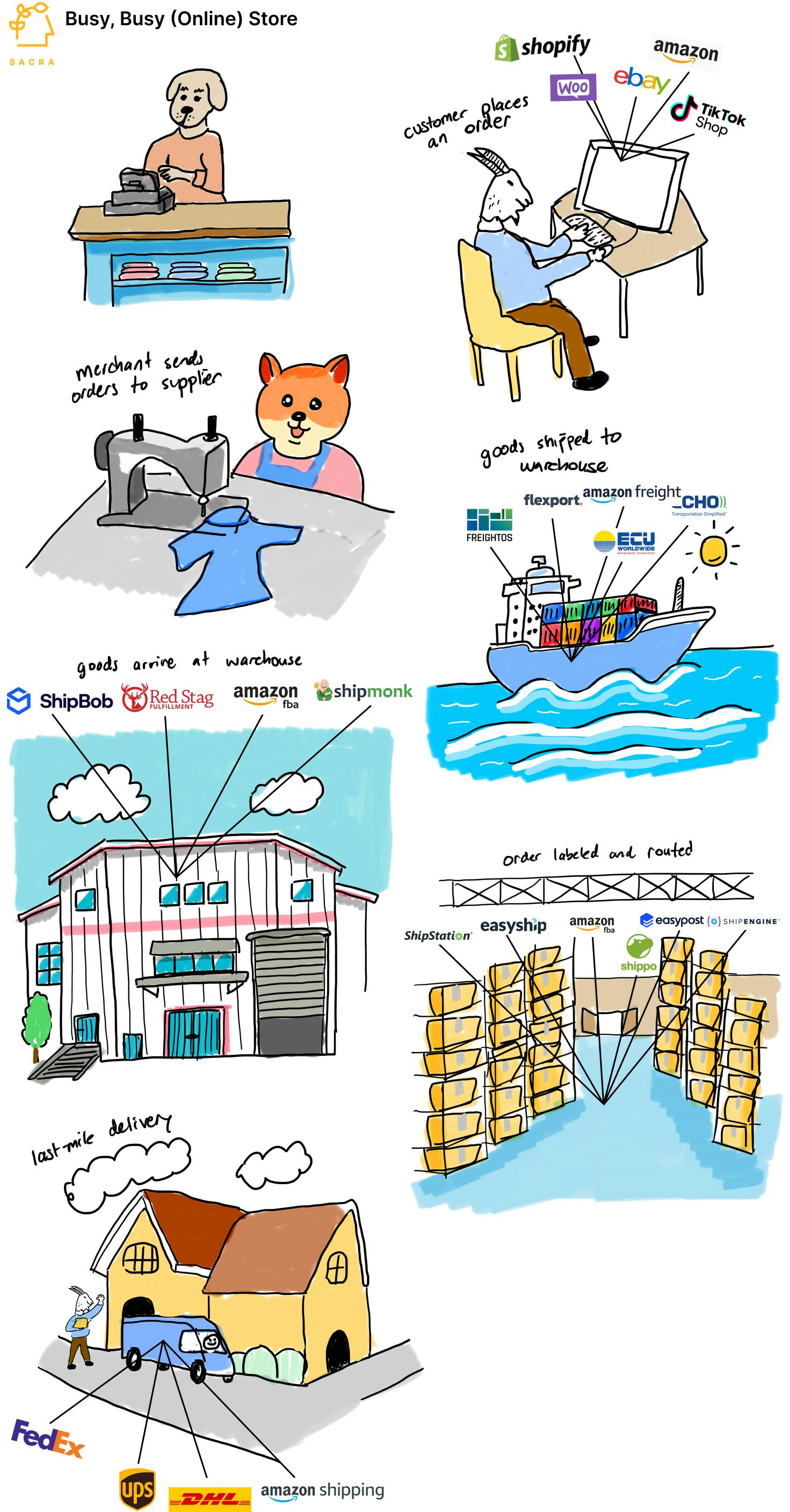
Across third-party logistics, a new competitive set is emerging as freight providers like Flexport, multicarrier fulfillment companies like ShipBob, ShipMonk and Red Stag, and APIs like EasyPost and Shippo converge on the vision of end-to-end ecommerce logistics.
Traditional carriers like DHL and FedEx are now building their own end-to-end ecommerce fulfillment platforms, looking to eat up the entire stack from order management to last-mile delivery.
TAM Expansion
Non-Amazon ecommerce GMV growth
The upside case for ShipBob lies in indexing on and facilitating the growth of non-Amazon ecommerce GMV—across ecommerce platforms like Shopify, social superplatforms like TikTok and big box retailers like Target—which hit $3.2T in 2023, up nearly 4%, with ecommerce as a whole going from 14.7% of all retail sales to 15.4%.
What ShipBob is building is the counterpoint to Supply Chain by Amazon, the new home of Amazon's $34B/year third-party seller services business as they look to eat up all of ecommerce, from discovery to distribution to delivery.
Social commerce platforms
ShipBob has positioned itself to capture GMV growth across emerging social commerce channels beyond traditional ecommerce platforms through strategic partnerships with Temu and SHEIN Marketplace that let U.S. ShipBob merchants sell on these platforms while fulfilling from existing U.S. ShipBob inventory. These partnerships complement ShipBob's existing TikTok Shop integration, creating a unified fulfillment layer across the fastest-growing social commerce channels.
International expansion
ShipBob is expanding deeper into Europe, with a Madrid fulfillment center opened in Q1 2026 enabling 2-day shipping across Spain, Portugal, Italy, and France—markets ShipBob pegs at nearly $200 billion in combined ecommerce value—providing Southern Europe coverage alongside the company's existing Northern European presence. The company has also grown UK fulfillment square footage by 50%, strengthening its position in its largest international market. International momentum was visible in BFCM 2025, where non-U.S. volume growth was led by Canada (+399%), Australia (+248%), France (+239%), Germany (+236%), and Ireland (+234%), indicating that international fulfillment is becoming a material growth vector rather than a nascent experiment.
Enterprise and embedded fintech
ShipBob has expanded TAM upmarket and into adjacent revenue streams through ShipBob Plus for mid-market and enterprise merchants and ShipBob Capital for merchant financing up to millions of dollars. These moves extend the company's addressable market beyond SMBs shipping under 400 orders/month and create new revenue streams from financial services embedded in the fulfillment platform.
Merchant multichannel and cross-border intent
ShipBob's 2026 State of Order Fulfillment report, drawing on surveys of 416 ecommerce executives, reveals structural demand for expanded fulfillment: 85.82% of brands already sell on 2+ sales channels, 43.99% plan to increase the number of fulfillment centers they use in 2026, and 43.51% plan to ship to or fulfill in new countries. These figures indicate that ShipBob's existing merchant base represents an organic growth vector—existing customers expanding channel and geographic coverage directly grows ShipBob's order volume without new customer acquisition.
Risks
Trade policy dependency: ShipBob's pivot to doubling FTZ space and launching a De Minimis Defense Program—driven by the August 29, 2025 suspension of duty-free de minimis imports and a merchant base where 79.56% report that 2025 U.S. tariff changes increased their costs—confirms that a meaningful share of its sellers relied on thresholds now permanently closed. Sudden reversals or further tariff escalation could destabilize the unit economics of the cross-border merchants ShipBob is actively courting.
Amazon encroachment: Supply Chain by Amazon gives Amazon sellers a vertically integrated fulfillment alternative backed by the same infrastructure that powers Prime, and Amazon has explicitly signaled intent to expand this to non-Amazon channels. ShipBob's core SMB and mid-market segments sit squarely in the competitive crosshairs as Amazon subsidizes fulfillment to lock in sellers.
IPO execution risk: The CFO hire and $4B IPO target come against a backdrop of compressed public-market multiples for logistics and fulfillment businesses, with no disclosed path to profitability. A failed or delayed listing limits ShipBob's ability to fund the fulfillment center expansion and international buildout required to stay competitive with better-capitalized rivals.
DISCLAIMERS
This report is for information purposes only and is not to be used or considered as an offer or the solicitation of an offer to sell or to buy or subscribe for securities or other financial instruments. Nothing in this report constitutes investment, legal, accounting or tax advice or a representation that any investment or strategy is suitable or appropriate to your individual circumstances or otherwise constitutes a personal trade recommendation to you.
This research report has been prepared solely by Sacra and should not be considered a product of any person or entity that makes such report available, if any.
Information and opinions presented in the sections of the report were obtained or derived from sources Sacra believes are reliable, but Sacra makes no representation as to their accuracy or completeness. Past performance should not be taken as an indication or guarantee of future performance, and no representation or warranty, express or implied, is made regarding future performance. Information, opinions and estimates contained in this report reflect a determination at its original date of publication by Sacra and are subject to change without notice.
Sacra accepts no liability for loss arising from the use of the material presented in this report, except that this exclusion of liability does not apply to the extent that liability arises under specific statutes or regulations applicable to Sacra. Sacra may have issued, and may in the future issue, other reports that are inconsistent with, and reach different conclusions from, the information presented in this report. Those reports reflect different assumptions, views and analytical methods of the analysts who prepared them and Sacra is under no obligation to ensure that such other reports are brought to the attention of any recipient of this report.
All rights reserved. All material presented in this report, unless specifically indicated otherwise is under copyright to Sacra. Sacra reserves any and all intellectual property rights in the report. All trademarks, service marks and logos used in this report are trademarks or service marks or registered trademarks or service marks of Sacra. Any modification, copying, displaying, distributing, transmitting, publishing, licensing, creating derivative works from, or selling any report is strictly prohibited. None of the material, nor its content, nor any copy of it, may be altered in any way, transmitted to, copied or distributed to any other party, without the prior express written permission of Sacra. Any unauthorized duplication, redistribution or disclosure of this report will result in prosecution.